
July 9, 2026
At a time when the HAS (French National Authority for Health) is considering extending the age range for starting mammography screening, and while the European clinical trial MyPEBS aims to offer personalized screening starting at age 40, Belgium is not recommending an extension of the age limits for this screening, citing the weak cost-effectiveness ratio of even the current screening program.
The full report can be read here in English: https://kce.fgov.be/sites/default/files/2026-07/KCE_423_Breast-Cancer-Screening_Belgium_Report.pdf
Already in January 2026
Ms. Ann Van den Bruel, Director General of the Belgian Health Care Knowledge Centre (KCE, Federaal Kenniscentrum voor de Gezondheidszorg), expressed her skepticism toward screening programs.
In an interview with De Morgen on January 24, 2026, Ms. Van den Bruel explained: “Doctors see cancer patients suffer and hope to avoid this through screening. It is unpleasant when anyone questions that.” She added: “Today, we hold a far too naive view of screening.”
July 2026: The KCE Report
In July of this year, the KCE (Belgian Health Care Knowledge Centre) published its report, issued under number KCE 423B, regarding the evaluation of the national breast cancer screening program.
The press release states in its introduction:
“According to the Belgian Health Care Knowledge Centre (KCE), the benefits of expanding regional organized breast cancer screening campaigns to older or younger age groups would be insufficient compared to its drawbacks. Furthermore, the cost-effectiveness ratio of an expanded screening program would be even lower than that of the current program, which is already questionable. Increasing screening frequency (annually rather than every two years) is also not beneficial in terms of cost-effectiveness. Adding ultrasound to mammography would increase the number of false-positive results without offering clinical added value. Moreover, it would only increase pressure on the healthcare system and budget. Currently, there are no sufficient grounds to support these adaptations.”
This represents not only a recommendation against expanding the age limits of mammography screening, but also, based on the wording, a questioning of the effectiveness of the current program itself.
Key Conclusions of the KCE:
The main scientific and policy conclusion of the KCE is that it does not recommend expanding the current age group for organized mass screening (which currently targets women aged 50 to 69 in Belgium, compared to 50 to 74 in France).
- Before age 50 (40–49 years): The KCE considers that the benefit-risk ratio is insufficient for systematic population screening due to higher rates of false positives, unnecessary follow-up examinations, and overdiagnosis.
- After age 70 (70–74 years): The KCE maintains a cautious stance, weighing overall life expectancy, comorbidities, and the major risk of administering heavy treatments for slow-growing tumors that would never have impacted patient survival (overdiagnosis).
The report also recalls the fundamental reason why this screening model cannot work. Indeed, the progression of breast cancer is not linear as previously imagined, meaning that the most severe and rapidly growing cancers are missed by screening.
The old model of linear, inevitable breast cancer progression is obsolete. Cancers can be rapid, slow, very slow, or even regressive. Read: https://cancer-rose.fr/en/2021/10/23/how-does-a-cancer-develop/
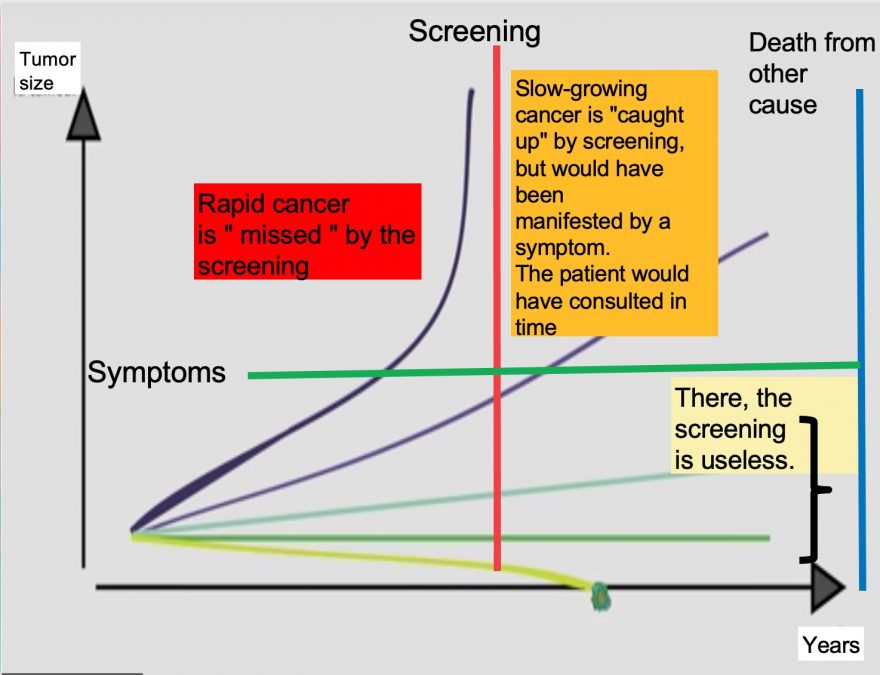
- Rapidly growing cancer (far left): Inherently aggressive with high velocity and a short residence time in the organ; it will be missed by screening. Metastases are often already present in lymph nodes or distant organs, even if not yet visible. It is often large at diagnosis because it grows quickly; “large” does not necessarily mean “late diagnosis.”
- Very slow, stagnant, or regressive cancer (the three green curves): Will not impact the patient’s life; it has a very long residence time in the organ and will therefore be preferentially detected by repeated screening exams. Its diagnosis is unnecessary for the patient, yet it will be treated with equal aggressiveness. It is small at diagnosis because it is slow; “small” does not necessarily mean “early.”
- Progressively growing cancer (purple curve): Will eventually become symptomatic and be detected by the patient due to clinical signs. This cancer can be treated in a timely manner because progression to a generalized stage occurs over a very long period (10, 20, to 30 years).
Policy Recommendations Issued to Decision-Makers
Recommendations are presented in a box at the end of the text:
To ministers responsible for Public Health, their administrations responsible for strategy and/or funding of screening programs, organizations that organize, promote, and/or conduct breast cancer screening, physicians involved in screening, professional and scientific organizations of general practitioners, gynecologists, and other healthcare providers concerned, health insurance funds, and patient organizations:
Participation in breast cancer screening is a personal choice.
Inform women in a clear, balanced manner about the scientifically established benefits and harms of breast cancer screening, as well as the uncertainties surrounding this information, to enable them to make an informed choice aligned with their personal values and preferences.
To ministers responsible for Public Health and their administrations responsible for strategy and/or funding of screening programs:
Regarding current screening programs for women aged 50 to 69:
- For women aged 50 to 69 who have made the personal choice to undergo breast cancer screening, offer mammography within the organized screening framework so they can benefit from quality assurance and the absence of out-of-pocket costs (copayments).
- Substantial uncertainties remain regarding the balance between clinical risks and benefits of breast cancer screening, as well as the cost-effectiveness of current screening programs. The likelihood that these programs are cost-effective is only plausible based on a number of optimistic assumptions that are highly uncertain to reflect reality. Factor this uncertainty into the prioritization and allocation of available resources.
Regarding a potential expansion of current breast cancer screening programs:
- In women under 50 years old, the balance between clinical risks and benefits is even less clear than in the current target group. Furthermore, breast cancer incidence is lower in this age group, leading to a less favorable cost-effectiveness ratio. Therefore, do not expand current screening programs to women under 50.
- In women aged 70 and older, breast cancer screening does not lead to a reduction in breast cancer mortality. Furthermore, there are insufficient reliable data regarding its harms (e.g., increased risk of overdiagnosis). Therefore, do not expand current screening programs to women aged 70 and older.
Regarding screening intervals:
- There are currently no data from randomized controlled trials regarding the benefits and harms of annual breast cancer screening compared to biennial screening, or triennial screening versus biennial screening. A shorter screening interval for the target group (e.g., annual screening) would lead to an unfavorable ratio between the additional number of breast cancers identified and the extra costs incurred. This would translate to a less favorable cost-effectiveness ratio than current biennial screening. Therefore, do not switch to annual screening.
Regarding screening combining mammography and ultrasound:
- Breast cancer screening combining mammography and ultrasound does not reduce breast cancer mortality while increasing the number of false positives. Therefore, do not expand the current mammography screening program by adding ultrasound.
To professional and scientific associations of physicians, gynecologists, and other healthcare providers, health insurance funds, and patient organizations:
- Strengthen efforts to provide women with clear and accurate information on the following points:
a. When a woman makes the personal choice to undergo breast cancer screening, it should preferably take place within an organized screening program. It is important to correctly inform her of the significant advantages of organized screening—namely quality guarantees (e.g., double reading of every mammogram and regular training for radiologists) that do not exist in opportunistic screening, as well as the absence of out-of-pocket costs.
b. There is currently no convincing evidence that annual cancer screening leads to health gains.
c. Routine combination of mammography and ultrasound for breast cancer screening does not reduce breast cancer mortality or overall mortality, while increasing false-positive results. This approach should therefore be discouraged.
- In medical education, ensure sufficient and continuous focus on the effects of cancer screening, proper interpretation of results, and the various types of bias that complicate the interpretation of screening effects.
To the Federal Minister of Social Affairs and Public Health, and the INAMI (Belgian National Institute for Health and Disability Insurance):
Current billing codes (nomenclature) do not distinguish between mammograms and ultrasounds performed for diagnostic purposes (e.g., women presenting with symptoms such as a palpable breast mass) and those performed as opportunistic screening. It is therefore impossible to evaluate: a) the extent of opportunistic screening, and b) its quality (e.g., sensitivity and specificity). Therefore, adapt billing codes to allow for both evaluations, and potentially enable the cessation of opportunistic screening if its quality proves inadequate.
In Conclusion:
Not only does the Belgian KCE strongly oppose expanding the screening age limits, but it also uses the opportunity to challenge the relevance and highly disappointing performance of the current framework.
Coincidentally, an Independent Researcher Speaks Out
Concurrently, independent researcher Peter C. Gøtzsche, in a text published here, denounces what he describes as systematic disinformation surrounding mammography screening.
His primary arguments and criticisms include:
- A Biased and Stifled Debate: The author asserts that his rigorous research and systematic reviews published as early as 2000 demonstrated that the majority of historical clinical trials supporting screening were methodologically flawed. He accuses the medical journal The Lancet and British institutions of deliberately burying scientific debate in 2012 by publishing a biased official report (the Marmot Report) to protect political and institutional interests.
- Nonexistent Benefits vs. Real Harms: According to his analyses, mammography screening does not reduce overall mortality and does not save lives. Conversely, it causes massive overdiagnosis (thousands of healthy women are falsely diagnosed with cancer) and leads to aggressive, unnecessary, and potentially fatal treatments, such as additional mastectomies or radiation therapy complications.
- Violated Medical Ethics: He strongly condemns official invitations and informational brochures from health authorities, deeming them misleading and guilt-inducing for women. By concealing overdiagnosis risks and artificially inflating benefits, these institutions prevent women from making a free and informed choice.
In conclusion, the author labels mammography screening a massive “scam” and advises women against undergoing it.
🛈 Nous sommes un collectif de professionnels de la santé, rassemblés en association. Nous agissons et fonctionnons sans publicité, sans conflit d’intérêt, sans subvention. Merci de soutenir notre action sur HelloAsso.
🛈 We are an French non-profit organization of health care professionals. We act our activity without advertising, conflict of interest, subsidies. Thank you to support our activity on HelloAsso.


