
New ACP Recommendations (American College of Physicians) on Mammography Screening
April 22, 2026, https://www.acpjournals.org/doi/10.7326/ANNALS-25-05116
The ACP* adopts a cautious approach centered on the benefit-risk balance of mammography screening. The younger the age, the worse the benefit-risk balance: the benefit is minor compared to the major drawbacks of this screening, which include overdiagnosis, false alarms, and unnecessary biopsies.
Hence the importance of a discussion with the patient and shared decision-making.
*The American College of Physicians (ACP) is a national organization of internist physicians who apply scientific knowledge and clinical expertise to the diagnosis, treatment, and healthcare of adults. With 137,000 members, the ACP is the largest medical specialty organization and the second-largest medical group in the United States.
Therefore, the ACP does not advocate extending routine screening to younger age groups (40–49 years). On the contrary, the ACP:
- Refuses a generalized recommendation before age 50
- Favors an individualized approach
- Emphasizes that risks may outweigh benefits in this age group
Context
In recent years, we have witnessed a debate over breast cancer screening recommendations, particularly regarding the starting and ending ages for screening.
First, New American Guidelines
In May 2023, the USPSTF—the U.S. task force responsible for public health recommendations—issued new guidance for mammography screening, advocating that routine mammograms begin at age 40.
This represented a 10-year lowering of screening recommendations compared to previous guidelines, which recommended breast cancer screening starting at age 50 due to increased risks for younger populations and an overly limited benefit.
The decision was driven by two arguments:
- An increase in breast cancer among younger women, and
- An increase in the most aggressive cancers among Black women.
We synthesized this announcement and the reactions it generated here: https://cancer-rose.fr/en/2023/05/16/lowering-the-age-for-starting-screening-but-at-what-cost/
This change in age recommendations raised significant protest, particularly regarding the argument presented about better “equality” of treatment for lower socioeconomic classes. This recommendation is by no means trivial, and the price women may pay could be very high. This is what prompted warnings from numerous scientists, which we reproduced here, here, and here.
However, as many opposing experts explain, the USPSTF guideline change was not based on new clinical trials on breast cancer screening that would justify such an adjustment.
Indeed, this modeling has been heavily criticized in academic literature, and not just on independent analysis websites.
The problem with modeling is that the results rely heavily on initial assumptions (tumor growth rates, treatment efficacy, screening compliance). The estimation of overdiagnosis is highly uncertain and difficult to measure empirically, and is therefore broadly modeled downwards. Population-level transposition yields average results applied to highly heterogeneous individuals. Advances in breast cancer treatment account for a large portion of the mortality benefit; thus, the benefit of screening decreases as treatments improve—especially considering that screening, particularly in younger women, carries numerous risks of false alarms, unnecessary biopsies, and overdiagnosis.
According to the Lown Institute, USPSTF modeling amounted to 7 deaths avoided for screening between ages 50–74, versus 8 deaths avoided for screening between ages 40–74—an incremental gain of saving one additional woman’s life. In exchange, however: +500 false positives, +60 unnecessary biopsies, and +2 cases of overdiagnosis per 1,000 women followed over their lifetime, which is quite a high price for women to pay.
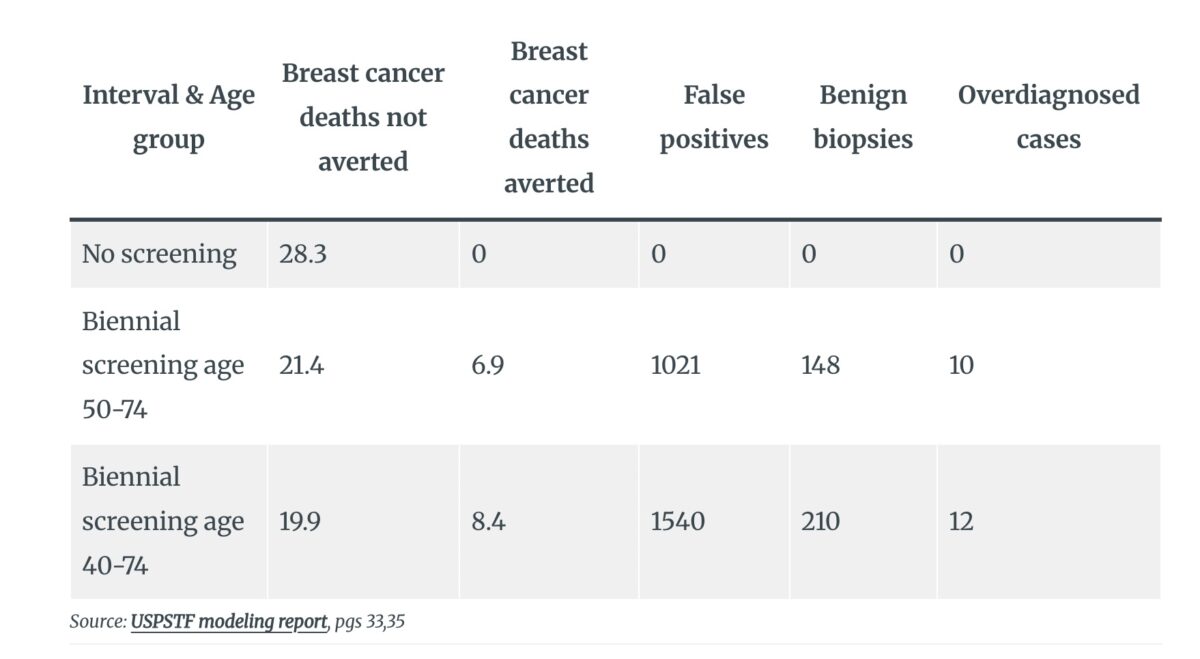
NB: Unfortunately, our French National Cancer Institute (INCa) also produced a modeling study whose results are built on thin air, as the model was deliberately chosen solely for the positive marketing of this screening. (Read: https://cancer-rose.fr/en/2026/03/07/womens-right-to-be-informed-is-flouted/)
One Year Later, New Canadian Guidelines
One year after these new American recommendations, it was Canada’s turn—via the CTFPHC (Canadian Task Force on Preventive Health Care, or CanTaskForce)—to publish new guidelines. These were based not on discussions or models, but rather on scientific evidence, literature reviews, and a known, transparent methodology.
Read here: https://cancer-rose.fr/en/2024/05/30/the-canadian-guidelines-on-mammographic-screening-have-been-updated/
The CanTaskForce was created by the Public Health Agency of Canada (PHAC) specifically to develop guidelines in various areas of clinical practice, including mammography screening.
The colossal work completed by the task force led to draft guidelines, available here, in the form of downloadable, easy-to-understand decision-aid tools for different age groups.
Regarding the 40–49 age group—which causes so much debate—the decision tool developed by the group is extremely cautious. It highlights the low expected benefit and emphasizes the necessity of a woman’s personal choice after being properly informed of screening harms.
“For women aged 40 to 49 years,” the text states, “based on current evidence (trials, observational studies, modeling, and a review of studies examining values and preferences), we suggest not undergoing routine screening mammography. Because individual values and preferences may differ, women aged 40 to 49 who wish to undergo screening after being informed of the benefits and harms should be offered screening every two to three years.”
Scientific evidence indeed does not support routine screening at this age, and a recent trial—the British UK Age Trial—supported this direction with results published in 2020.
Unfortunately, a stunned scientific community watched helplessly—despite support from all sides—as the group’s work was halted due to political interference (from the Canadian Health Minister) and pressure from powerful patient associations dissatisfied with the non-recommendation for women in their 40s that everyone was expecting.
Despite a counter-response from the Canadian group based on scientific reasoning, the CanTaskForce was dissolved in November 2025—an unprecedented event.
We related this calamitous and incomprehensible affair here: https://cancer-rose.fr/en/2025/03/07/the-truth-if-im-lying/
The ACP Publication
The ACP’s literature search to establish its own recommendations was based on five eligible guidelines:
- American College of Obstetricians and Gynecologists (ACOG)
- Brazilian College of Radiology and Diagnostic Imaging / Brazilian Society of Mastology / Brazilian Federation of Gynecology and Obstetrics Associations (Brazilian Society)
- Canadian Task Force on Preventive Health Care (CTFPHC) (draft version)
- European Commission Initiative on Breast Cancer (ECIBC)
- U.S. Preventive Services Task Force (USPSTF)
According to Table 1, the best recommendations in terms of methodological rigor, clarity, and greater inclusion of women’s choice originate from the Canadian CanTaskForce and the ECIBC (European Commission Initiative on Breast Cancer). The USPSTF recommendations were judged to be less robust and less practical for clinical use.
The primary ACP recommendations are as follows:
- For the 50–74 age group: Screening continues to be recommended via mammography every 2 years; according to the ACP, this is the age range where the benefit-risk ratio is most favorable.
(We will revisit this recommendation below in our “Comments” section at the end of the article, as internationally renowned researchers do not share this conviction. Furthermore, emphasis could have been placed on informed choice and shared decision-making for this age group. We discuss this further in our comments.)
- For the 40–49 age group: There is no routine recommendation. The decision must be individualized (doctor–patient discussion) and must account for: patient preferences, individual risk levels, and the perception of benefits/risks.
Why this caution? Because benefits are uncertain or modest while risks become more significant, namely:
- False positives
- Overdiagnosis
- Overtreatment
- Anxiety
- Radiation exposure
- Beyond age 75: Stopping screening should be discussed; screening is no longer routine and will depend on life expectancy and overall health status.
The ACP also examines specific cases regarding dense breasts
The college of internists suggests the optional addition of digital breast tomosynthesis (DBT). MRI and ultrasound are not recommended for routine screening.
The summary of Tables 3 and 4 in the publication concerning women with dense breasts highlights the following findings:
- There is no solid evidence that tomosynthesis (or 3D mammography, a technique functioning similarly to a breast CT scan) reduces overall mortality compared to standard mammography.
- Both tables reflect a somewhat counter-intuitive situation: while more cancers are detected using tomosynthesis, it is not shown that women live longer. Three possible (and likely combined) explanations exist:
- Overdiagnosis: Detection of cancers that would never have killed the patient.
- Lead-time bias: Cancers are detected earlier, moving up the “birth date” of the diagnosis without altering the final outcome.
- Length bias: It primarily detects slower-growing cancers rather than aggressive ones that prove fatal.
For women with dense breasts (Table 4), there are no data on mortality—and thus no proof of benefit—despite higher detection rates, increased radiation exposure, additional exams, false positives, and unnecessary biopsies.
Read here https://cancer-rose.fr/en/2022/05/17/update-on-tomosynthesis/ : More intensive screening techniques (such as tomosynthesis) increase cancer detection, but no solid evidence shows that they reduce mortality from breast cancer.
Performing more imaging does not guarantee dying less or saving more lives.
Concise Summary of the ACP Publication
The ACP (American College of Physicians) does not advocate for extending screening to younger age groups (40–49 years):
- Refuses a generalized recommendation before age 50
- Highlights the greater risks in this age group
Conclusion and Comments from CR
The ACP aligns with the rather cautious recommendations previously issued by the CanTaskForce. The college insists on non-recommendation before age 50 and stresses caution alongside case-by-case decision-making with the patient. It does not support lowering the age for routine screening and emphasizes the need to consider screening risks and patient informed consent.
We can draw a comparison between the screening “philosophies” of the USPSTF and the ACP:
- Point of agreement: Based on similar available data, both agree there is negligible benefit before age 40 and, conversely, clear risks.
- USPSTF perspective: Concludes that despite a low individual gain, even a moderate overall benefit justifies a population-wide recommendation for mammography screening starting at age 40. They argue that across millions of women, more lives saved justifies accepting many adverse effects—while remaining silent on deaths attributable to the adverse effects of overtreatment, which are not evaluated. Nor is there concern regarding informing women.
- ACP perspective: Warns against major risks of mass screening, including overdiagnosis AND overtreatment, significant psychological burden, anxiety, radiation, and invasive unnecessary biopsies. Its reasoning is centered more on the individual patient, leading it to refuse recommending earlier screening.
Furthermore, the USPSTF neglects what is central to the Canadian task force and to our own point of view: informed choice and shared decision-making WITH the woman, which the ACP explicitly emphasizes.
Why do we disagree with the ACP recommendation for routine screening in the 50–74 age group?
In the most recent update of the Cochrane review (2013), researchers stated:
“Eight eligible trials were identified… We found that breast cancer mortality was an unreliable outcome, biased in favor of screening, mainly because of differential misclassification of causes of death. Trials with adequate randomization did not demonstrate an effect of screening on total cancer mortality, including breast cancer, after 10 years (RR 1.02, 95% CI: 0.95 to 1.10) or on all-cause mortality after 13 years (RR 0.99, 95% CI: 0.95 to 1.03).
The total number of lumpectomies and mastectomies was significantly higher in screened groups (RR 1.31, 95% CI: 1.22 to 1.42), as was the number of mastectomies (RR 1.20, 95% CI: 1.08 to 1.32). The use of radiotherapy was also more frequent…
If we assume that screening reduces breast cancer mortality by 15% and that overdiagnosis and overtreatment reach 30%, it means that for every 2,000 women invited to screening over a 10-year period, 1 woman will avoid death from breast cancer, while 10 healthy women who would not have been diagnosed without screening will be treated unnecessarily. Furthermore, more than 200 women will experience significant psychological distress, including anxiety and uncertainty, for years due to false-positive results.
…Given considerable advances in treatment and improved breast cancer awareness since the clinical trials were conducted, it is likely that the absolute effect of screening today is lower than in those trials. Recent observational studies show greater overdiagnosis than in the trials and very little or no reduction in the incidence of advanced cancers due to screening.”
Screening does not save lives.
Even for age ranges where the ACP maintains a screening recommendation (50–74 years), we believe it is crucial for women to be aware of the benefit-risk ratio—hence our development of decision-aid tools.
And reactions are already pouring in…
In Radiology Business (you can’t make this up), American radiologists are reacting and expressing their dissatisfaction:
🛈 Nous sommes un collectif de professionnels de la santé, rassemblés en association. Nous agissons et fonctionnons sans publicité, sans conflit d’intérêt, sans subvention. Merci de soutenir notre action sur HelloAsso.
🛈 We are an French non-profit organization of health care professionals. We act our activity without advertising, conflict of interest, subsidies. Thank you to support our activity on HelloAsso.


