
“Breast cancer screening reduces mortality by 21%.” This slogan was heard for a very long time, but is less emphasized today as it is increasingly challenged. Indeed, since 2015, more and more studies have shown the major impact of therapeutic progress on the decline in mortality—a decline that was already noticeable before screening campaigns were implemented. They also show that the effect of screening on reducing the risk of death is very marginal, if not non-existent. This must be weighed against the side effects of screening, which are a measurable reality, such as overdiagnosis, radiotoxicity, and false alarms.
But what does it actually mean when it is claimed that mortality is reduced by 20%? Does it mean that 20 fewer women out of 100 screened will die of breast cancer? Not at all.
It refers to a relative risk reduction, which is a percentage calculated by comparing a group of screened women to a group of unscreened women.
What does this mean in real life, across a population?
If out of 2,000 screened women, 4 die of breast cancer, and out of an unscreened group of women, 5 die of breast cancer, the drop from 5 to 4 mathematically represents a 20% reduction in mortality. However, in absolute numbers, this represents a difference of only one woman… (5-4 / 5 = 0.2 = 20%)
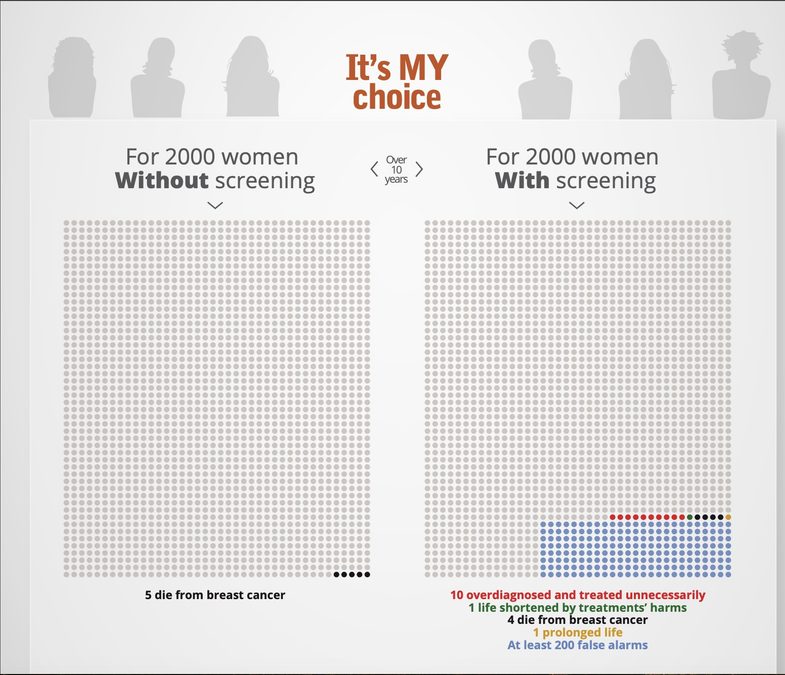
This is why we must always demand that data be presented in real numbers rather than percentages, which embellish the situation and do not reflect real life.
There has indeed been a favorable trend in cancer mortality over recent decades, particularly since the 1990s:
This is a well-known phenomenon, which is currently known to be mostly attributable to treatments, the discontinuation of routine prescriptions for hormone replacement therapy (HRT), better vigilance from women who consult a doctor when warning signs appear, and perhaps finally reaping the benefits of campaigns addressing risk factors. Several impact studies note that:
- The decrease in mortality, wherever observed, is more pronounced in younger age groups of women.
- It exists just as much among unscreened women (Miller study).
- It is lower than for other forms of cancer, despite colossal resources being deployed for breast cancer screening.
- Other forms of cancer are also experiencing this decline in mortality, even though these cancers are not included in organized screening campaigns.
- Impact studies show that the reduction in mortality is attributable to anti-cancer therapeutics developed since the 1990s.
- The decline in mortality does not correlate with the timing of the introduction of organized screening. It is noticeable as early as the 1990s, whereas screening began in the 1980s in the US and Sweden, but only in 2004 in France. In the UK, between 1985 and 1993, there was an 11% drop in breast cancer mortality, even though screening only became operational in 1988.
- A 2023 study shows that the risk of dying from breast cancer has indeed decreased over recent decades, whether screening took place or not, due to significant therapeutic progress in breast cancer treatment—and that is excellent news to share with women.
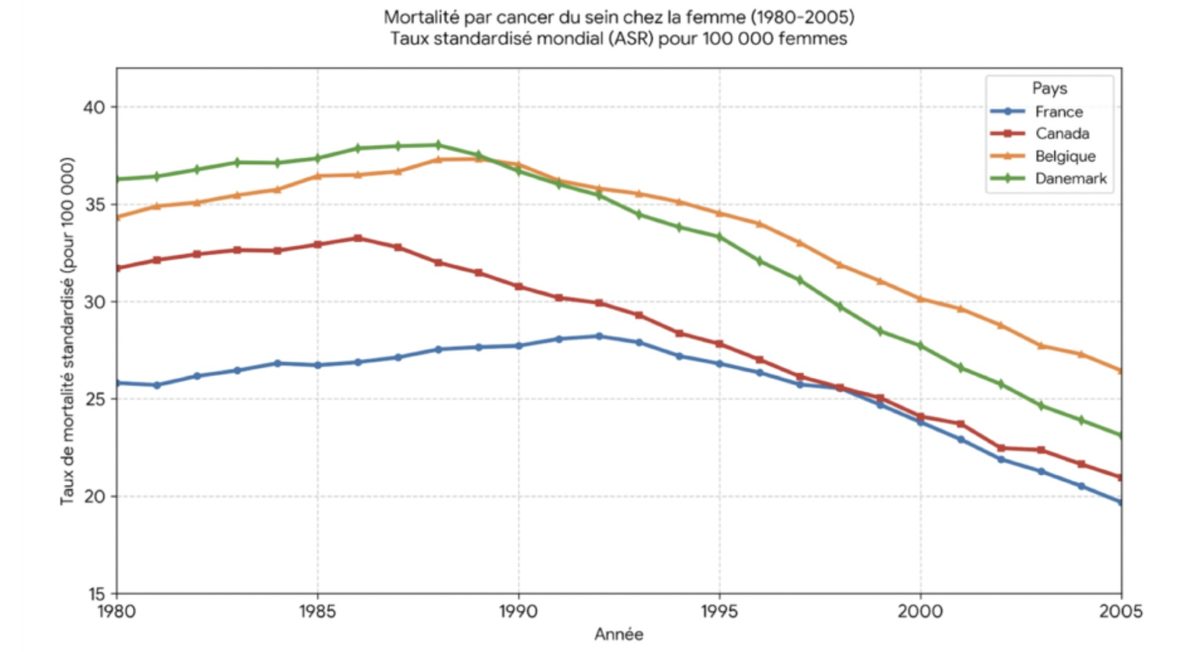
Graph representing the evolution of breast cancer mortality rates in women, age-standardized at the global scale (ASR World) per 100,000 women, between 1980 and the mid-2000s for France, Canada, Belgium, and Denmark. These curves are based on historical epidemiological data shared by the Globocan project and the WHO mortality database (IARC).
In Belgium, screening was generalized in 2001–2002. In France, 2004. In Denmark, 2007–2010. In Canada, 2000. The decline has been constant in all these countries and predates the introduction of national campaigns. If screening were the primary cause, the decline should be even more pronounced and plummet as soon as screening is generalized across the population (meaning from 2001 in Belgium, 2004 in France, 2007/2008 in Denmark, and 2000 in Canada). Yet, this effect is not visible. Even without screening, improving treatments helps reduce mortality.
The current scientific consensus is as follows: breast cancer mortality has indeed been declining since the 1990s. This decline is multifactorial, with the distribution heavily favoring treatments as playing a major role (≈50% or more effective, even for advanced stages). Screening, on the other hand, plays a secondary and moderate role (and one must consider that mass screening simultaneously carries risks, such as overdiagnosis).
Ultimately, even without screening, improving treatments helps reduce mortality and avoids the adverse effects of screening. (Donald A. Berry et al., New England Journal of Medicine, 2005)
Modern treatments significantly reduce mortality but also reduce the absolute benefit of screening. In other words, the more effective treatments are, the less “added value” screening provides (Annals of Internal Medicine, 2016, Birnbaum et al.)
The Swiss Example: An interesting fact illustrated here is that mortality drops in a similar manner in Swiss cantons with low screening participation (German-speaking areas, green curve) compared to those with high participation (French- and Italian-speaking cantons, blue curve).
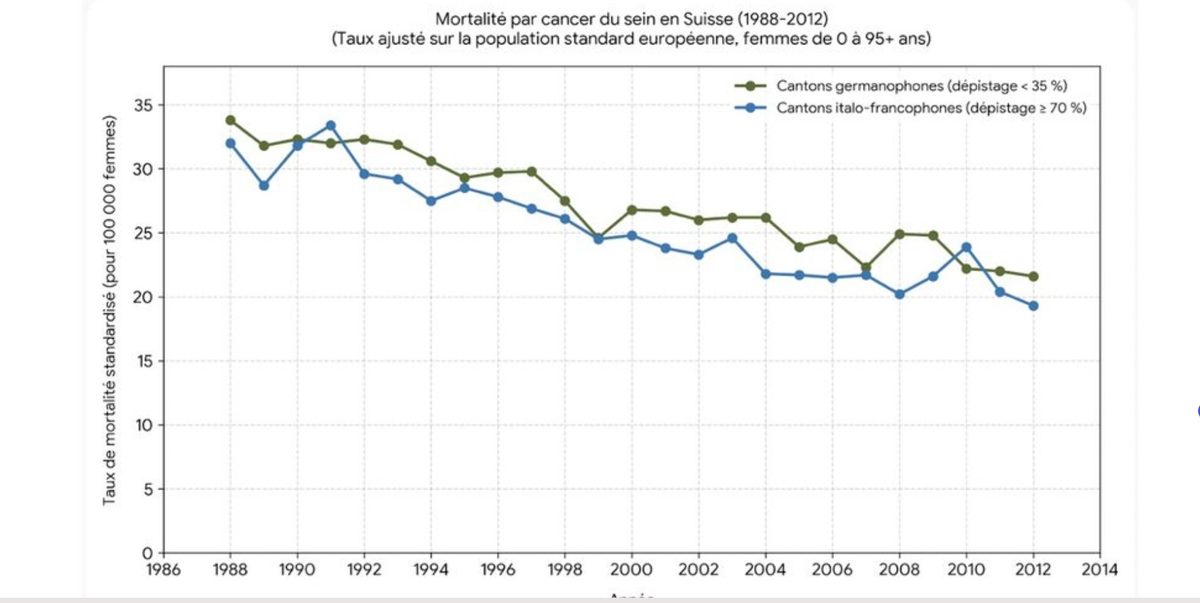
Evolution of breast cancer mortality rates in Switzerland between 1988 and 2012,
German-speaking cantons (screening < 35%)
Italian- and French-speaking cantons (screening ≥ 70%)
Metric: mortality rate adjusted to the European standard population
for the age group 0 to 95+ years. (IARC, Swiss Medical Board)
🛈 Nous sommes un collectif de professionnels de la santé, rassemblés en association. Nous agissons et fonctionnons sans publicité, sans conflit d’intérêt, sans subvention. Merci de soutenir notre action sur HelloAsso.
🛈 We are an French non-profit organization of health care professionals. We act our activity without advertising, conflict of interest, subsidies. Thank you to support our activity on HelloAsso.
