
Summary, translation, and commentary by Cancer Rose, November 7, 2026.
Cancer Screening: A Blessing or a Curse?
By Willem P.Th.M. Mali and Yolanda van der Graaf
This is an article available here: https://www.ntvg.nl/artikelen/screenen-op-kanker-zegen-vloek published in the Nederlands Tijdschrift voor Geneeskunde (NTvG), or Dutch Journal of Medicine.
It is a leading scientific and medical journal, and one of the oldest medical journals in the world still in operation. It functions independently with a peer-review system. Professor Yolanda van der Graaf served as editor-in-chief and is one of the article’s authors.
Willem P.Th.M. Mali and Yolanda van der Graaf are two prominent Dutch medical professors and researchers, primarily affiliated with the University Medical Center Utrecht (UMC Utrecht).
Prof. Dr. Willem P.Th.M. Mali is Professor Emeritus of Radiology. A specialist in medical imaging and vascular diseases, he headed the radiology department at UMC Utrecht for many years. Prof. Dr. Yolanda van der Graaf is a Professor of Clinical Epidemiology, specializing in the contribution of medical imaging.
Article Summary
Cancer screening seems intuitively logical: we want to detect it early to prevent the situation from worsening. This article describes the complexity hidden behind this assumption. Early detection relies on the idea that cancer grows linearly, but this conception is now outdated. Cancers develop at highly variable speeds; some stop growing or even disappear spontaneously.
Read : https://cancer-rose.fr/en/2023/06/26/what-is-the-natural-history-of-cancer/
The main problem is overdiagnosis. Due to breast cancer screening, approximately 2,000 women are treated each year in the Netherlands for a form of cancer that would never have caused symptoms. Epidemiological data show a steady increase in Stage I cancers, while Stage IV cancers remain stable—a clear sign of overdiagnosis.
Screening has two sides, the authors explain: on one hand, it has the potential to detect cancers; on the other hand, it leads to unnecessary treatments due to overdetection, whose corollary is overtreatment accompanied by side effects.
Its effectiveness, they say, must be proven by randomized trials demonstrating a reduction in cancer-specific mortality and overall mortality. Citizens, according to them, deserve honest information about the difference between the intuitive utility of cancer screening and the scientific evidence that justifies it.
In summary, screening is only effective if it reduces mortality, not simply by detecting more cancers.
The Intuitive Theory
Intuitively, cancer screening seems useful; we want to perform it at an early stage so that the patient can be cured. But screening also leads to overdiagnosis and excessive treatment, which means it often defeats its own purpose. The question that remains and that the two scientists ask again: does cancer screening reduce mortality?
Until the 1970s, cancer was exclusively perceived by society as a clinical illness that began with symptoms and weight loss, followed by a tumor, metastases, and ultimately death. Generally after months of suffering during which surgery, radiotherapy, and chemotherapy played a role—most often for palliative purposes, rarely curative. This was the vision of the cancer spectrum deeply anchored in society; in reality, a diagnosis equated to a death sentence. What could be more logical then than to intervene early, to detect cancer as soon as possible to prevent the situation from worsening?
Our intuition tells us that this is exactly what needs to be done. But the question of whether cancer screening is truly effective can only be settled scientifically, at the population level. The two authors emphasize that the screened individual cannot judge this based on personal experience; indeed, for the individual, the doctor, the oncologist, and the pathologist, there is only a diagnosis, which everyone believes will have been life-saving. Overdiagnosis can only be identified at the population level, when epidemiologists compare populations subjected to different screening intensities and notice an anomaly: an increase in cancer diagnoses in screened populations despite unchanged mortality and unaltered rates of advanced cancers.
The authors cite the prominent scientist and oncologist Barnett Kramer, who perfectly summarized the essence of this problem in the title of his 2009 publication: “Cancer screening: the clash of science and intuition.”
KramerBS,CroswellJM.Cancerscreening: the clash of science and intuition.AnnuRevMed.2009;60:125-37. doi:10.1146/annurev.med.60.101107.134802. Medline
The Early Screening Paradigm
But how did this idea of early screening come about? The two authors trace a brief history of the genesis of the screening concept.
First, there was the German pathologist Virchow, who demonstrated the cellular origin of cancer and laid the foundations for the linear growth model—meaning the appearance of cancer in the mammary gland followed by metastasis to the lymph nodes and other organs.
The American surgeon Halsted then translated this knowledge into a radical surgical treatment for breast cancer, consisting of removing the breast, lymph nodes, and chest wall muscles.
His surgery was highly mutilating, and we pause here to recount the intellectual deception of this surgeon. It was Halsted who developed this linear and mechanistic theory of cancer on which screening has relied for decades.
Claiming to defeat breast cancer: an old story
In 1894, Halsted, a renowned North American surgeon, claimed to achieve a cure for breast cancer through extended ablation. Progress in surgery at the end of the 19th century allowed women to no longer die on the operating table. This technical advance was mistaken for a victory over the disease.
Halsted adopted the classic framework of an organ disease with progressive locoregional and then general extension. A small tumor corresponded to an early diagnosis, synonymous with curable. Any delay in diagnosis harmed the patient. The breast was the ideal organ for this model: it is external and non-vital, which seemed to facilitate diagnosis and treatment. Thus, for Halsted, everything seemed aligned to defeat breast cancer through extended surgery. Halsted pushed the removal of the breast and its surroundings to the extreme, performing true mutilation with severe thoracic sequelae and sometimes a disabling swollen arm. But this was supposedly the price to pay for a cure. In 1894, William Halsted announced three recurrences after 50 interventions, a remarkably low rate of only 6%. With Halsted’s announcement, the generalization of radical surgery as a cancer treatment began in industrialized countries.
But a detailed examination of his operations performed up to May 1892, for which there was at least a 2-year follow-up, shows that 16 of the first 25 women operated on (64%) had recurred or died. Halsted himself had observed that 24% of patients without lymph node involvement whom he had operated on had nonetheless died.
In 1907, Halsted published his results.
The two authors of the Dutch article explain that the main conclusion of Halsted’s 1907 publication was that among patients in whom the tumor was also detected in the lymph nodes, only 25% were still alive after 3 years, while among patients in whom the tumor remained confined to the breast tissue, 65% were still alive. Based on the linear growth model, it was assumed that this latter group of patients had forms of cancer that constituted a preliminary stage compared to the first group. This result therefore seemed to prove that early detection improved the survival rate. Halsted’s method remained, for the next 70 years, the crucial discovery.
According to historian Barron Lerner, write Mali and De Graaf, the impact of this discovery cannot be overstated. Indeed, in 1919, the American Society for the Control of Cancer (ASCC)—the precursor to the American Cancer Society (ACS)—declared that cancer was primarily a local disease that could be cured if detected at an early stage. For the rest of the century, this message shaped the scientific agenda of cancer research…
End of the Linear Growth Model
The linear growth model was only replaced at the end of that century, after it was demonstrated—notably thanks to knowledge gained from cancer screening—that cancer could develop at highly variable speeds. Not only could the growth rate vary considerably, but sometimes tumors did not grow at all or entered regression (Figure 1).
Fast-growing tumors appeared between screening cycles, while very slow-growing tumors were discovered during autopsies performed on patients who died from another cause. This latter reservoir of cancers is present in almost every organ. In the prostate, for example, the percentage can reach 80% in people aged 80, but it is also found in the breast, lung, thyroid, and skin.
Caption: Traditional model and new model of cancer progression
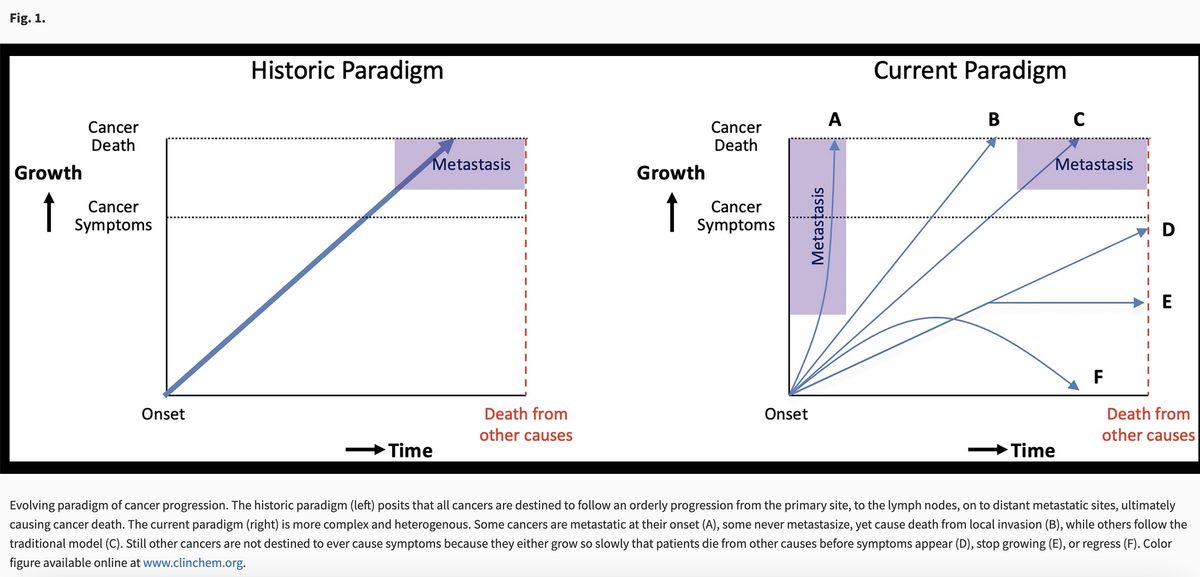
Figure 1 is a schematic representation of the (a) traditional model and (b) new model of cancer progression. The traditional model assumes that all cancers follow an identical progression trajectory, moving from the primary site to locoregional lymph nodes, then to other distant organs, ultimately leading to death. The new model is more complex and heterogeneous. Some cancers metastasize from the very beginning (A), some never metastasize but lead to death through local invasive growth (B), while others follow the traditional model (C). Other cancers never cause symptoms because they grow so slowly that patients die of other causes before symptoms appear (D), or they stop growing (E) or eventually disappear (F).
D, E, F constitute overdiagnosis.
A is the cancer that is metastatic from the start and missed by screening.
B and C are cancers with a more linear progression, but they will produce a symptom long before the metastatic phase, leading the patient to consult in time (B is a cancer that develops regionally but does not metastasize).
Natural History of Cancer
In the context of cancer screening, it is important to know the natural history of the disease, the authors remind us. We must know that there is a stage of development where the tumor presents no symptoms and has not yet metastasized, but where it can already be treated effectively so that the patient is cured.
The problem is that the natural history can only be studied if a patient is not treated, which is unacceptable for both the patient and the doctor. Only the control group of a randomized controlled screening trial contains patients with untreated cancer, allowing us to learn about its clinical significance.
What these authors explain is that, ethically, one could no longer replicate a comparative randomized trial today between a group of women who would be screened and a group of women who would not be. Yet, such a trial was conducted by a team of researchers from Oslo in 2008, where two groups of women were compared: one screened every two years, the other examined only once at the end of six years. Result: there was a 22% excess of cancers in the screened group. However, if all tumors progressed into perceptible cancers, there would be the same number of cancers in these two groups of women with identical profiles. Finding more in the group screened every two years means there is an excess of unnecessary cancer diagnoses that would never manifest, simply because of screening.
(Read : https://www.nejm.org/doi/10.1056/NEJMoa2208375)
New Methods for Early Screening
Methods were sought to detect cancer at an early stage. New methods included the cervical smear, mammography, stool test, colonoscopy, CT scan, ultrasound, and many others. All these methods were initially used to detect the early stages of an invasive cancer that had not yet caused symptoms.
All these tests yield false-positive results, even if in a small proportion. But within the framework of a 25-year breast cancer screening program, the percentage of false positives reaches 14%, which means that 24,000 participants per two-year cycle are often gripped by great, unjustified anxiety for weeks.
A New Screening Objective
Very quickly, non-malignant anomalies were also discovered and were then considered pre-stages of invasive cancer; eliminating these anomalies became a second objective. This is how cancer “prevention” appeared among the objectives of screening, alongside the early detection of already present cancers.
But it is not certain that these precancerous lesions progress to invasive cancer; this process can span 10 to 15 years, and probably no more than 10% to 30% of them ever result in invasive cancer. The true significance of these precancerous lesions—meaning whether they also lead to metastases or death—has been relatively little studied.
Recently, a randomized controlled trial with significant statistical power and a large study group was conducted on colon cancer screening via colonoscopy, during which polyps were also removed preventively; the study showed no benefit in terms of cancer-specific mortality or overall mortality.
It is therefore accepted as obvious that most patients are treated for nothing. If the treatment is simple, this seems completely justified. In the case of cervical and colon cancer screening, the treatment is simple and low-trauma, although it concerns a considerable number of patients.
Thus, during a colon cancer screening cycle of 30,000 patients, advanced adenomas are removed by colonoscopy. In the case of ductal carcinoma in situ (DCIS) of the breast, however, the treatment often consists of a radical mastectomy. Yet, DCIS has an extremely high 10-year survival rate after surgery, even higher than that of the general population.
The surgeon will probably say that this is due to their intervention, but a recent randomized controlled trial (RCT) suggests the contrary: the progression of in situ lesions is extremely benign, even without surgery.
PutsGCWM,Wauben-SpaetgensBMME,LuthTTK,KruijtAW,AlbadaA,PraagmanJ,VisserO.Ontwikkelingvandekansopkanker in 1990-2019. Ned Tijdschr Geneeskd. 2023;168:D7498.
https://www.ntvg.nl/artikelen/ontwikkeling-van-de-kans-op-kanker-1990-2019
We will add two other remarks to this: on the one hand, treating carcinomas in situ does not prevent the appearance of invasive breast cancer, and on the other hand, the overdetection of carcinomas in situ, which are inherently lesions with a very good prognosis, heavily feeds the pool of overdiagnosed lesions.
Because of screening, the authors confirm, many relatively benign cancers are added to the number of discovered cancers, which misleadingly improves survival rates over time.
Indeed, let us open a parenthesis here: in France, our INCa (National Cancer Institute) tirelessly reports that breast cancer survival is excellent and attributes it to screening.
What is the reality, and what is survival? Survival is by no means a marker of screening effectiveness. Survival—meaning the proportion of people still alive 5 years after diagnosis—is higher when treatments are effective, but also when overdiagnosis is high. To use an analogy, you could say that thanks to a triple antibiotic therapy, you find there are no more cases of pneumonia; certainly, but if you treat everyone with three antibiotics at the first sign of a runny nose, you have also massively treated people who would never have developed pneumonia anyway, and you have caused massive antibiotic resistance.
Here it is much the same: the more you screen, the more you find lesions that would never have killed, but because you have treated everything massively, you can present excellent survival figures, since you have treated people who, by definition, would never have fallen ill or died.
The second thing that the French INCa is careful not to explain to you is that 5-year survival is excellent for cancers with a good prognosis. This is a condition: for cancers with a poor prognosis, however, such as triple-negatives, we are far from an 80% survival rate…
Screening brings forward the ‘birth date’ of the cancer, giving the illusion of longer survival, but in no way affects the life expectancy of the individual.
If you want to know the effectiveness of screening, there are two essential criteria: mortality and the rate of advanced cancers. Neither of these two criteria has been improved by mammographic screening.
Epidemiological Signatures
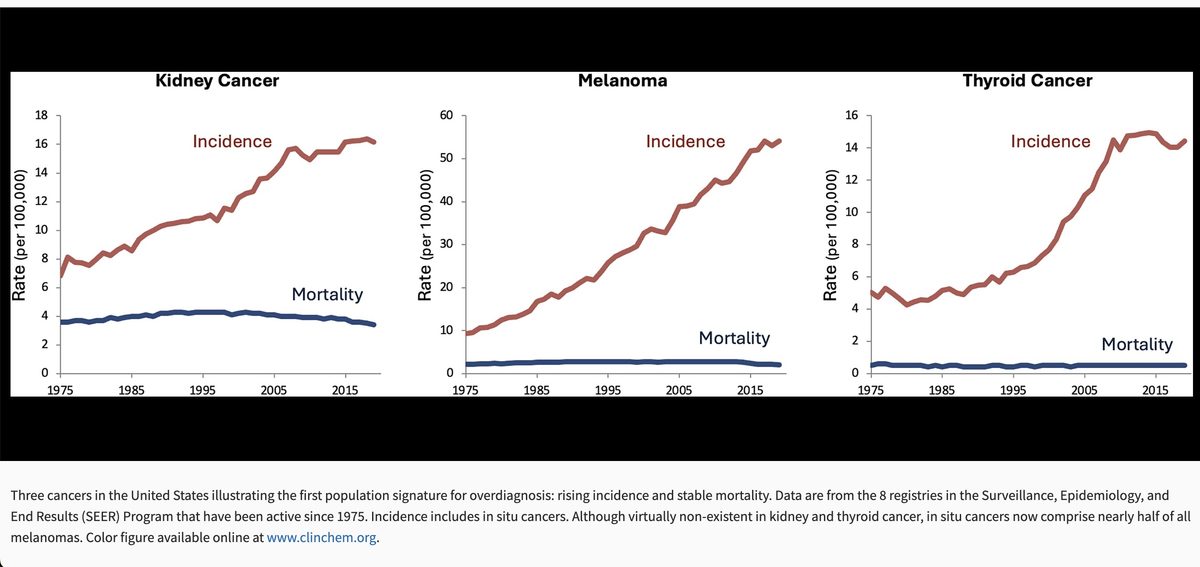
In 2019, the American internist and researcher Gilbert Welch proposed examining the epidemiological signature of cancer.
The juxtaposition of trends in incidence (the number of new cases) and mortality of a cancer can easily reveal overdiagnosis, says G. Welch.
The first signature corresponds to the disconnection between a cancer’s incidence which, as soon as screening is introduced, skyrockets, while the specific mortality for this cancer remains stable—even though we should expect it to decrease, since theoretically, the more we screen for cancer cases at the so-called “early” stage, the more fatal cancers we should avoid. This is not verified for the cancers taken as examples (kidney, melanoma, thyroid) nor for breast or prostate cancer.
The second epidemiological signature corresponds to the disconnection between the increase in the incidence (rate of new cases) of early-stage cancers found by screening, but without any change in the incidence of more advanced stages of cancer. Clearly, screening allows for the harvesting of low-malignancy stage cancers, raising hopes that this would lead to fewer advanced stages of cancer—those that are the most difficult to treat and that kill. It is nothing of the sort; screening allows for the recovery of early stages of cancer without, alas, reducing the most aggressive cancers in the same proportions, because the latter are unfortunately very fast, aggressive from the start, and escape screening. This is what is illustrated in the figures from G. Welch’s article.
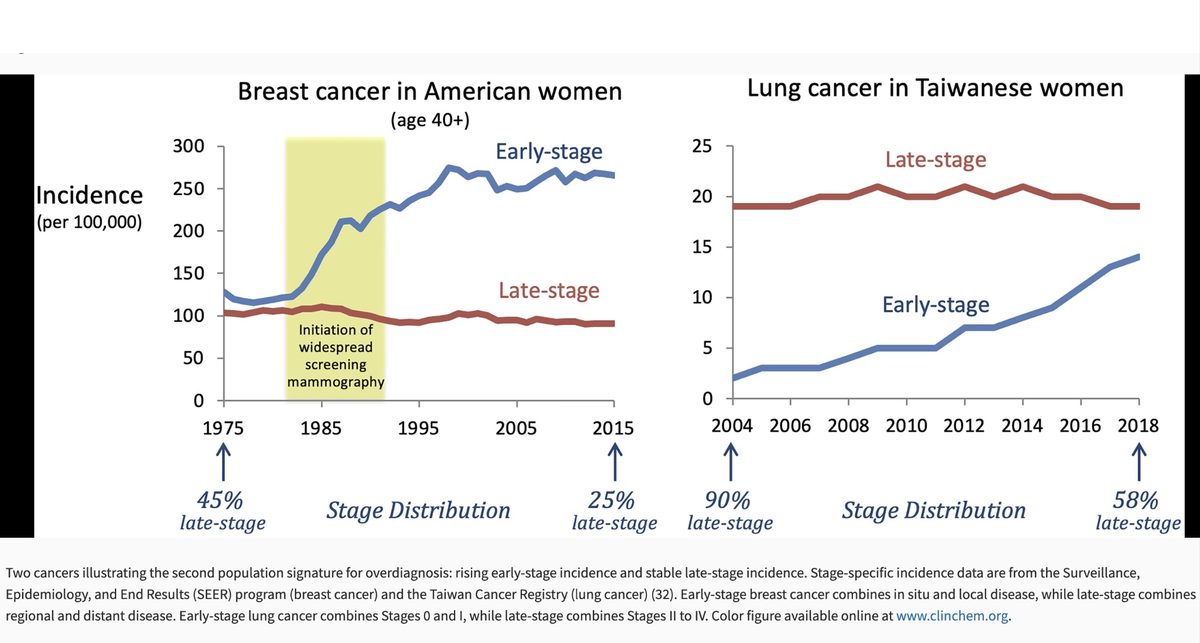
In the article, the authors produce this figure. What does it show?
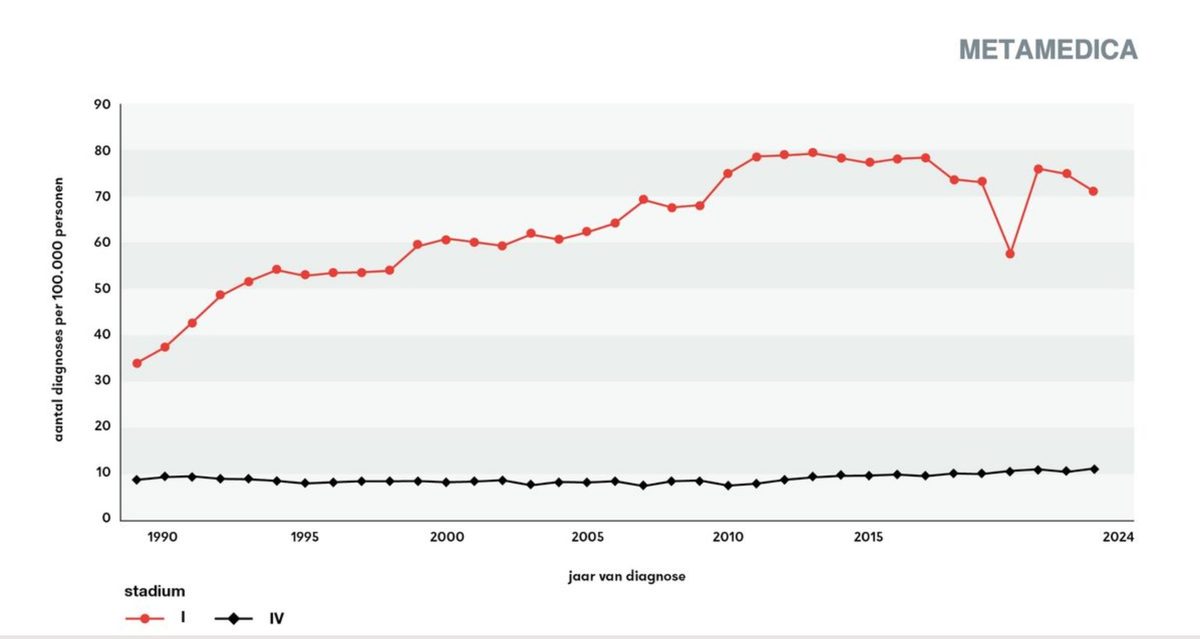
It is the annual incidence of invasive breast carcinoma and ductal carcinoma in situ, expressed as the number of diagnoses per 100,000 women over the period 1989-2024, broken down by the number of cancer diagnoses at Stage I and Stage IV (source: Netherlands Cancer Registry [NKR]). In red are the low grades, in black the most advanced stages of cancer.
==> Since the introduction of breast cancer screening in 1989, there has been a strong and durable increase in the number of Stage I cancer diagnoses, while the number of Stage IV cancer diagnoses remains stable.
This means that we are treating a very large number of Stage I cancer patients in whom the disease probably rarely progresses to Stage IV, the authors say.
Why is this? We mention here the study by Lannin, which shows that good-prognosis cancers and poor-prognosis, aggressive cancers derive from different cell lines. This means that the most unfavorable cancers do not originate from the “good” cancers that we detect. These bad, Stage III or IV cancers are unfavorable from the start, so you can hunt down as many small, low-grade cancers as you want; it does not curb the rates of the most advanced cancers because these stem from cell lines that possess unfavorable and aggressive biological characteristics from the outset.
Let us return to the article. What does this mean concretely in numbers for the situation in the Netherlands? The magnitude of overdiagnosis—meaning the number of excess tumors detected due to screening—can only be calculated from randomized trials, simply by comparing the incidence in the screening group to that of the control group during the follow-up period. Figures from the literature consistently show that incidence is up to 25% higher in screened women.
Harris R. Screening is only part of the answer to breast cancer. Ann Intern Med. 2014;160(12):861-3. doi:10.7326/M14-0616. Medline
ZackrissonS,AnderssonI,JanzonL,ManjerJ,GarneJP.Rateofoverdiagnosisofbreastcancer15yearsafterendofMalmö mammographic screening trial: follow-up study. BMJ. 2006;332(7543):689-92. doi:10.1136/bmj.38764.572569.7C. Medline
During a biennial cycle (2022-2023) of the breast cancer screening program, breast cancer is detected in more than 11,000 women (www.rivm.nl). This means that more than 2,500 women are treated for a form of cancer that would never have caused symptoms. Signs of this overdiagnosis are also observed in the report of the breast cancer evaluation committee (LETB 2023) (www.rivm.nl). Over the period 2006-2017, a three times higher, unchanged incidence is observed in the screening group compared to the non-screening group. Of course, these groups are different, but in effective screening programs, one expects incidence to decrease in the screening group after the first cycle and not remain at a level three times higher for years.
However, if this incidence remains so high despite removals and treatments, it means that Stage I cancers are constantly appearing but probably have little significance, since the control group (unscreened) does not show an increase in Stage III and IV cancers.
This corresponds to the extremely high 10-year survival rate of 95% in these screened patients, because screening, in the vast majority of cases, detects these good-prognosis cancers.
One could even say that the very fact of having a cancer found by screening is a guarantee of a good prognosis, but also of unnecessary detection.
Lessons Learned
We can make a number of observations regarding cancer screening. Independent of the above considerations, we should learn lessons from the mistakes made in the area of screening for early stages of invasive cancer, assert Mali and de Graaf. These failures are all due to the absence of high-quality randomized studies.
Take the example of screening for neuroblastomas in very young children. This example cited by the authors refers to a screening program launched in the 1980s for all children aged 1 year, in order to screen for neuroblastoma, which is a tumor with an extra-cranial location (neck, abdomen, thorax) more common before the age of 5. There are 130 to 150 cases per year in France, half of them before age 2. To do this, a high concentration of catecholamines is sought in the urine, a hormone secreted by this tumor. It was realized that neuroblastomas often regressed spontaneously during the first year of life and required no treatment. Organized programs had been set up in Japan (1970), Canada (especially in Quebec from 1989 to 1994), and Germany (1995).
All neuroblastoma screening programs were discontinued in the early 1990s for three reasons: there was no decrease in the incidence of advanced neuroblastoma compared to regions without screening, no reduction in neuroblastoma mortality, and instead, a considerable overdetection of small, non-progressive neuroblastomas that disappeared spontaneously.
BertholdF,SpixC,ErttmannR,HeroB,MichaelisJ,TreunerJ,etal.Neuroblastomascreeningat1yearofage:thefinalresultsofa controlled trial. JNCI Cancer Spectr. 2021;5(4):pkab041. doi:10.1093/jncics/pkab041. Medline
https://academic.oup.com/jncics/article/doi/10.1093/jncics/pkab041/6265474?__cf_chl_tk=kYqAfegM4iTxxROt1j7X4hzgZEdSN_mxlgVWYqcfKf4-1793720814-1.0.1.1-.PdxyzKcM.hUTBboJdlU8cASaHbMuvK.nxi1M74hUrM
The authors also cite thyroid cancer screening in South Korea, where thousands of people were diagnosed and treated for papillary or follicular thyroid cancer. These too are forms of cancer that are generally benign and require no treatment.
AhnHS,KimHJ,WelchHG.Korea’sthyroid-cancer”epidemic”–screeningandoverdiagnosis.NEnglJMed.2014;371(19):1765-7. doi:10.1056/NEJMp1409841. Medline https://www.nejm.org/doi/10.1056/NEJMp1409841
It is possible that the preventive removal of precancerous lesions is effective, but this MUST be demonstrated by high-quality randomized clinical trials. A recent study showed that the models used for this purpose are too unreliable; they heavily overestimate the potential effects of screening. This overestimation is mainly due to the assumption that the target population participates at 100%, whereas in reality, this percentage is lower by tens of points.
Before proceeding with screening, we must demonstrate that it leads to a decrease in cancer-specific mortality, which then reduces overall mortality. Opponents argue that this requires studies that are too vast. For the authors, this argument is peculiar, because we then proceed to screen millions of people with an unproven method, which moreover costs much more than a randomized trial, ultimately bringing very little in terms of benefits to the population.
Read : https://cancer-rose.fr/en/2023/09/08/screenings-dont-extend-lifespan/
Authors’ Conclusion
In recent years, it has become clear that cancer screening has not constituted the major breakthrough we hoped for.
In addition to these disappointing medical results, many societal aspects also invite a critical judgment.
Major drawbacks include the shift of healthcare toward testing rather than useful care (117,000 colonoscopies in a biennial screening cycle), high costs when a truly comprehensive calculation is made (including or excluding the costs of colonoscopies at 1,200 euros per patient), poor information regarding risks, as well as the medicalization of large segments of the population due to false-positive test results, overdiagnosis, and overtreatment.
It seems time, as recommended by a recent report from the “Council for Public Health and Society”, to re-evaluate cancer screening.
Iedereenbijnaziek–Overdekeerzijdevandiagnose-expansie.DenHaag:RaadvoorVolksgezondheidenSamenleving;2024. https://www.raadrvs.nl/adviezen/i/iedereen-bijna-ziek
In doing so, the two authors conclude that we must also involve healthy citizens more; after all, they undergo all of this without having a say in the process and must make a decision based on very incomplete information (www.raadrvs.nl).
They continue: “the oldest screening program we have—that for cervical cancer—has never been the subject of a randomized clinical trial; the participation rate has fallen below 50% and human papillomavirus (HPV) vaccination has further reduced this low incidence. We could decide to phase out the program and no longer accept new participants.
We must also recognize, as with lung cancer screening, that if the Health Council concludes in 2025, after 25 years of study, that it is not clear ‘whether the benefits outweigh the disadvantages’, its utility is apparently difficult to establish and it is better to focus on other interventions that have proven effective, such as smoking cessation.
Advies‘Screeningoplongkanker’.DenHaag:Gezondheidsraad;2025.
Rather than early screening, cancer prevention might well be the best way forward.”
🛈 Nous sommes un collectif de professionnels de la santé, rassemblés en association. Nous agissons et fonctionnons sans publicité, sans conflit d’intérêt, sans subvention. Merci de soutenir notre action sur HelloAsso.
🛈 We are an French non-profit organization of health care professionals. We act our activity without advertising, conflict of interest, subsidies. Thank you to support our activity on HelloAsso.


